
Transcript
(upbeat intro music)
Ally: Welcome to the Digital Creator Podcast, the show where we spotlight students working on cool digital projects. I’m Ally, a consultant at the Digital Knowledge Center where we empower students to be digital creators. Today’s guest made the most out of DKC resources to refurbish, customize, and display Monster High dolls.
Opal: Hello, my name is Opal Johnston. I’m a studio art and K through 12 education major. And my pronouns, any are fine. Graduation year, 2028.
Ally: All right. So just to start off, can you tell us a little bit about the project that you’re doing here at the DKC? And you can talk about any of them.
Opal: Okay, perfect.
Ally: It’s up to you.
Opal: Yeah. Honestly, kind of like a vast majority. What I really like most about this space is it’s like how like versatile it is. There’s like a lot of things that you can do. And as an art major in particular, like for me, that’s just like kind of like a playground. It’s like really fun. And the main thing that I’ve kind of been working on, my most recent project, has mainly revolved around the 3D printer. That’s kind of been like my pride and joy here, just because I feel like it’s like kind of a tool that I’m never really going to get to use again. So I feel like, you know, live it up while you can and get to know it as best as humanly possible. And so I’ve been playing with that because, before college, I never touched one in my life. So I’ve been making, like, those little pegboards that like IKEA has. Yeah, I made some of those, but like miniature versions, because I’m really into like Monster High. And so I have like a, I have a collection going, but I couldn’t hang them in my dorm because there’s like, you can only use push pins. And so I thought these pegboards would be a great alternative. And so I was able to 3D print them and kind of play around with them. And I was able to literally like put the little push pins into the wall with the holes in the pegboard. And so it worked pretty good. And I was able to make some like makeshift shelves from that as well.
Ally: Yeah, that’s awesome. I love when people come in to use 3D printer for like functional, like functional things that are still very creative. Can you talk a little bit about like how you first found yourself at the DKC?
Opal: Honestly, it was through my FSEM. I feel like it’s very common. Like I see it like all the time that I’m in here, especially in the fall when it’s like everything’s starting out that all the FSEMs are coming in to kind of tour the space. My FSEM in fall of freshman year was with Dr. Hubbard. I did the positive psychology one, which was super fun. Very like laid back and chilled course. But part of that course was basically introducing us to all of our like resources on campus because that is like a great way to like I don’t know, just be positively involved with your space around you was kind of like the theme of the course. And so the DKC was one of them that we toured and that kind of introduced me to the space. I think mainly where it is. I feel like that’s when you first come on campus, you’re like, where is everything? I know it exists, but where is it? And I think just knowing where it is, like I saw the equipment. I was like, I’m going to be back here. And that was kind of like my first like intro to it. And then from there, like since I’m just a like genuinely creative person, like for me, it was like, a no-brainer that I would be back for some project of some sort.
Ally: Yeah. So how did that kind of evolve for you? Like what did you start with at the DKC that now has sort of like as you’ve learned more skills, you just keep coming back. Like what was your first foray into this?
Opal: My first was just like the general craft supplies, you know, using that for like miscellaneous like class projects. And then I eventually moved to doing the training for the 3D printer. because I had wanted to just experiment with it in general, but I remember having a project for my intro to SPED class where we were kind of talking about different accessible tools. And I wanted to do mine on, oh wait, no, it wasn’t accessible tools. I wanted to do it on accessible tools. And in particular, I wanted to kind of like bridge the world of art and education. And so I talked about like art accessibility tools. So a lot of painters or drawers that either don’t have limbs or don’t have like good movement of them actually use their mouth to paint. And it’s really, really cool. And so for my project, I literally did a time lapse of me painting with my mouth, but I had to 3D print like a knob that would hold the brush. And so it was like a knob that just went on the end of the brush and that would make it so I could hold it in my mouth. And so that’s what I 3D printed. And that was like the first like project that I did really here.
Ally: Yeah, that’s really cool. I feel like that’s something that we’ve been trying to highlight a lot more in the FSEM presentations is that we do have sort of like general crafting supplies. I feel like that’s a good bridge into sort of seeing what else we have in the center. And I think it’s also cool that your first project was sort of also served a sort of function for accessibility and now kind of your more recent one. is again sort of using the 3D printer for problem solving. Have you always been interested in like displaying Monster High dolls? Like how did that, how did you kind of get into that as well?
Opal: I think that’s been, that one’s been a long time coming. But honestly just living in the Fredericksburg area because the thrifting here is so good. That’s how I get my Monster High dolls. They’re so expensive reselling. And so I’ve actually locally been able to find, and I like actually like refurbish them.
Ally: Okay, I was gonna ask.
Opal: Yeah, so that’s kind of been like my main thing as of recent, I’ve always kind of been a collector. Like, toys is like my favorite thing to collect, but the Monster High brand in particular, as well as a lot of Lalaloopsies, are like my 2 go-tos. So those are kind of like growing collection in the corner.
Ally: Yes. Well, now on pegboards.
Opal: Exactly, yeah. It’s perfect.
Ally: Yeah, I see a lot of people using Monster High dolls for like, not just refurbishing, but also completely repainting. Is that something that you dabble in as well? Or is it mostly sort of keeping them as they are, but, fixing anything that like might have been damaged or anything like that?
Opal: I do both. The world of customs is very new to me. So that’s something I’ve also been using the DKC for. So I did the pegboards actually because I’m working on a custom right now and I wanted to be able to like display the ones that I had. But I’m definitely like not a professional at it because there’s like just a lot of niche little like details and there’s different products that people recommend for like the face repaints. And so I’ve kind of just been like playing around with the one extra that I did have. But other than that, I do like to kind of keep them in their original condition because there’s like, you know, varying rarities of these dolls depending on like what generation, there’s three Monster High generations, G1, G2, G3, and G1 obviously is the rarest if it’s not the core crew. And so it’s like, you kind of get into that area of, you know, when was this doll produced, how much of it was made? And that kind of like dictates, at least for me, if I will customize them or not.
Ally: Yeah. And then with your being a, like an art major, do you feel like that sort of has also informed how you kind of approach that both with like redesigns and refurbishment. I don’t know if that makes sense.
Opal: That does make sense. But yeah, I think yes, because I think I’m a little more out there with my customs just because of like my art background. I feel like I want to use more materials for the outfit. I want to kind of like pile things together. I want to experiment with different textures. I want maybe the face paint not to just be like a normal like redo. Maybe I want her makeup to be a little more boom, you know, like things like that I feel like definitely have played a role in at least my understanding. And also just like the technical like skills behind it. Like the doll’s faces are very tiny. So my background in painting is very helpful for kind of like navigating that. So that has definitely been an adjustment, is like the tiny space. I know people are really into miniatures, so that’s like another area where that skill kind of comes in handy. But for me, it’s like, it’s kind of a skill that I already had like built. It’s just getting used to a different scale. So I think a lot of like that has been helpful.
Ally: Yeah, that’s interesting too, because we have a lot of people come in to use the 3D printer to create miniatures. So I think it’s really interesting that you’re using yours to sort of display your piece as well. So kind of going back a little bit to the pegboards specifically, did you run into any challenges with the design of that? And did you find the design from a repository or like kind of how did you go about working out how exactly you wanted those to function for your project?
Opal: So I found the design online. Like there’s a bunch of different like places you can look. And I kind of like circulate through designs. I’m still new to like 3D modeling. So I didn’t feel quite comfortable with the scaling yet of making my own. But that is something that I want to work on, specifically with like shoe redesigns for the dolls. So that’s kind of something I’m working on. I’m in a makerspace class right now for the COE. And so like that’s like my end project. And I’ll use like the 3D printers and all there as well for that purpose. But it was definitely, I think, a challenge. even once I found the model, my biggest problem that I had was the scaling of it. Because it’s really hard, at least for me, since I’m like a visual person, to kind of like visualize how it’s going to come out on the printer, like from computer to printer. And I think I was having a hard time with that. I was able to get the boards the size that I wanted them to be. But when it came to the shelves, I actually like printed them out too small, and I had to like scratch that idea completely. And so I ended up only using the stands for the shelves in the end and just got little pieces of wood that I kind of put on. So yeah, I think something that’s something in the future I’d like to kind of have more of a grasp on is, scaling it in the actual slicing program and how it translates to the actual printer.
Ally: Yeah, and that’s something too that like, I find a lot of projects with the 3D printer have some aspect of trial and error with them. You obviously, like, especially when you’re trying to connect things, make sure that different features will fit together and like join in that way. That’s like, that can be very difficult. So similarly to like challenges, what do you think has been the most rewarding aspect of this? Like is it having it physically? Is it the process of learning how to 3D design and print?
Opal: I mean, I think when I think of that question, I think of more of the DKC as a whole. Like I don’t kind of zone in on specific projects. I kind of focus on like what has the DKC like done for me and like what kind of space has it provided? Because for me, it’s not necessarily like the project outcomes. It’s more of the experimentation, which I feel like a lot of artists will kind of back me in that statement. But like being able to have a space where I can kind of have this freedom to play around with things has kind of like, one, gets you out of your dorm. You got to have something to do. And I think that for me has been rewarding and also focuses on like my own personal interests outside of the classroom. And I think that’s like kind of a balance that I’ve struggled with a lot. I think a lot of other students do too. And so I think That’s really what the reward is to me is I’m like, I’m out here doing something. I’m learning a new skill. And also people don’t even realize, but while things 3D print, you can work on homework, which is what I often do. I kind of just like, it gives me a focus and a safe zone.
Ally: Yeah, for sure. And I think a lot of people don’t realize like that you can come here and do personal projects, right? Which I know that we try to push in the FSEM presentations and appointments and things like that is anything you can come into the DKC for anything, whether it’s for an academic project or just for something you want to do for yourself. We’re a resource for students. So yeah, so I so back to kind of your like involvement with the center as well. Like, do you have any thoughts? I know you mentioned like you’re in the makerspace class and you’re kind of work towards like the 3D printing the shoes. Like, do you have an idea for what sort of your next project is going to be? Or like, are you still planning to like continue on? with the pegboards in a different way? Like how are you kind of seeing the future of the projects here?
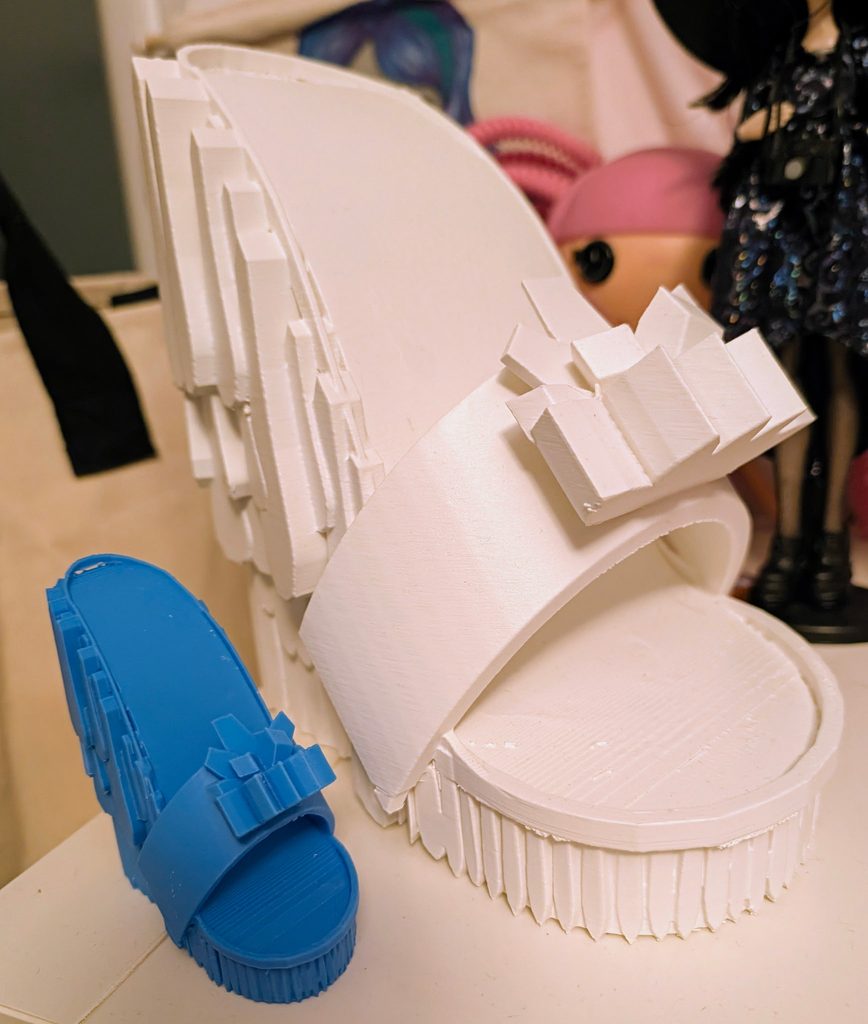
Opal: I think with the pegboards, now that I transferred to the wooden shelves, I do want to stain them, but I’m also kind of wondering if I want to make two more pegboards so I can connect them as like one big block. Because I have two right now, so if I kind of connect them all together, it’d be like one big. So I’m kind of considering that along with staining the wood. But I think mainly right now, as I have the time, my biggest project is going to be for that class designing the shoes. Because I kind of came up with that idea because 3D modeling is something I want to learn how to do. But also because when I thrifted this doll, she didn’t have any shoes. And so she’s the one that I’m customizing. And so I want to kind of recreate a model that’s her original shoe design. And so that’s kind of my goal. And I think going forward, that’ll be what I focus on, because I think that one’s going to take the most like time and attention to detail. Because right now I have enough dolls where the shelves aren’t like a problem. Like I have spaces for each of them as of currently. So I think, I don’t know, it might be a future semester problem for me.
Ally: Yeah. And I know that like Monster High shoes specifically are very intricate, like as well as like most of the other accessories that like come with those dolls. So I can definitely see it being very challenging to sort of work out those intricacies in like a digital modeling software. But that’s very exciting. But like that’s the next thing because, she needs some shoes.
Opal: I know that’s what I’m saying. I’m like, a girl needs her stilettos.
Ally: Yes. And I mean, I feel like too, like stylistically Monster High dolls like have that vibe to them that like they should be in a shoe.
Opal: Like, Oh no, yeah, she is that queen. She is that diva.
Ally: Yeah, it’s like Barbie can get away, I feel like, with not having shoes. Maybe that’s controversial.
Abby: No, I agree.
Opal: No, yeah, she can do it. She’s meant for like the, I don’t know, that’s the dolls I always played with growing up. Well, obviously Monster High too. But I don’t know, I would always lose the shoes, so maybe that’s on me.
Ally: Exactly. But I feel like Monster High, you need to like complete the look.
Abby: At my house, we have a little bucket of just like singular shoes where the other one has gone missing.
Opal: That’s so funny. Yes. Can relate.
Abby: Like the hope that someday we’ll find the other because we never got rid of the other one. So.
Ally: And I feel like that’s kind of the eternal struggle of doll shoes is, where do they go?
Opal: You never know.
Ally: New project for me, maybe? Figuring that out .
Opal: Maybe
Abby: The dryer sock.
Ally: The dryer sock, the Barbie shoe. The like last piece of a puzzle, of a jigsaw puzzle.
Opal: It’s like, I feel like we just need one bucket. We can collectively sort out. Like this is the “I lost the piece” bucket.
Ally: Exactly, So I think that that’s really cool to kind of incorporating all the other aspects of doing a customized doll that honestly, a lot of the tools we have here at the DKC could help with. I mean, we have sewing machines.
Opal: I know, yeah, that one I’m excited as well, because I do sew. So embroidery and sewing is like a big thing that I do. And so I’m kind of excited for that. at least from an outfit perspective for the customs, but that’s something I also have to figure out. But the big challenge I’m kind of like still pondering on about the shoes is the flexibility of them. I feel like a lot of people don’t realize, but the doll shoes can’t be made out of pure PLA because it won’t actually glide in. So it’s like I have to either purchase a more flexible filament, which are available, or kind of figure out how do I fit the shoe with the PLA. So that’s kind of like what I’m going on to now is because the foot of the doll is naturally curved. And so it’s like, I have to think about that, which can be challenging with the amount of detail of the original shoe. So yeah.
Ally: And I’m also like curious about with that, I don’t remember are, Monster High feet articulated at all or is it just the legs?
Opal: No, they’re not articulated.
Ally: So, not a lot of wiggle room there.
Opal: That’s why it’s like it can’t be the PLA. It’s like it has to slide like right in. So I almost feel like if I start with a base. So when you kind of do your digging, I do digging quite often, but there’s bases that actually mold to the bottom of the doll’s feet already. Then like maybe if I build off of that, I’d have a shot.
Ally: Yeah, because I was curious too if like on some of the 3D design repositories, maybe someone’s done something similar that you could like work off of. and kind of make your own in that same way.
Opal: I feel like that might have to be the go-around, but then I’m really going to have to learn how to understand scaling, because then it comes, I would still slide it. have to slide the foot in and it wouldn’t be flexible enough. So I’d have to actually increase the base size and then build around that.
Ally: Right.
Opal: So that’s the weird part.
Ally: Yeah, and that’s I think too where trial and error comes in again. Like you’re gonna be making a lot of doll shoes.
Opal: And that’s okay.
Ally: And then you can maybe use that for another project, you know, like make a necklace of all your failed.
Opal: That’d be so cute as earrings.
Ally: Yes.
Opal: We’re on to something. We’re on to a business idea.
Ally: I’m sold- sharks today. Yeah, okay, great. Do you have anything you’d like to add before we ask our final question?
Opal: No.
Ally: Wonderful. Well, then we have one more question for you today. And you have kind of answered it a little bit, but just for our egos, would you recommend other people come to the DKC and utilize all of our resources here?
Opal: Yeah, I did kind of, yeah, I know what you’re saying. I did answer this. Yes, I would definitely recommend. I feel like it is a great resource. And as someone who’s like constantly crafting, constantly doing things, like save yourself that money. Like this is in our tuition. It has resources that I feel like, I don’t know, I’m kind of in the group of people that’s like, okay, we’re paying for this and at some point we’re gonna lose it. So use it while it’s here. And so I feel like that is definitely something to learn from. And there’s never anything You should be scared about when, encountering like a new material, a new piece of equipment. Like I feel like it’ll just teach you different ways to approach things. And I feel like that’s just a valuable life lesson either way.
Ally: Yes, And building transferable skills.
Opal: Yes, this is great for jobs people.
Ally: Yes. All right. Well, thank you so much for coming in and talking with us today. I can’t wait to see kind of where you go with this shoe project and how you, like, refurbish these dolls and customize them. Yes. Thank you.
(upbeat outro music)
Ally: This has been the Digital Creator Podcast. You can find a transcript of our conversation and more about this project below. This podcast was produced and edited by me, Ally Hamilton, with help from Angela Payne, Abby Firestone, and the resources at the Digital Knowledge Center. Are you interested in becoming a digital creator? Do you have a cool project you want to share? Go to dkc.umw.edu for information on how to get started! Thank you for listening!
For more information on all of the resources available at the Digital Knowledge Center visit the DKC site.
Reply